The Bedfordshire Regiment in the Great War

1918 War Diary Appendices
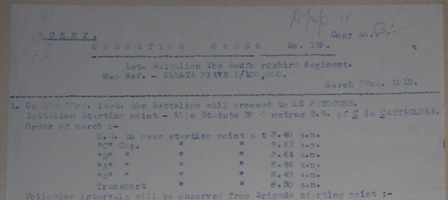
[Note that all remarks in squared brackets are my own additions and not part of the original text]
January 1918
APPENDIX I. HONOURS AND AWARDS
The following have been awarded the Military Cross: Captain L.G. Plumbly. "A" Company. 2/Lieut.A.V. Clark (Posthumus [sic]) "B" Company. No.5914 R.S.M. Theobald.
The following N.C.O. has been awarded the Military Medal : 37099 Sergt. Trowell, L. "B" Company.
The Following Messages are between Captain Spicer of B Company and other Officers, found mixed up with the 1st Battalion War Diary:
"From O C B Coy To Adj NOBLE Situation Report ARTILLERY
At 8 and 11 pm enemy shelled Sunken road at R.4.a.8.6. and Trench junction R.4.a.60.65 for four minutes (4.2") 30867 Pte J.A.Prior M.G.keep traversing along my front other-wise all is quiet Wind N.E. 1.30 am 1-1-18 F.T.Spicer Capt O C B Coy NOBLE"
"From O C B Coy To Adj NOBLE
Work done Report Continued consolidating along E bank of Sunken road from R.4.b.0.9. to R.4.a.8.1. WIRING Single fence of Barb wire from Cable Trench R.4.a.85.10 to R.4.a.90.60. (380 yds) with four yard gap every 100 yds. 1-1-18 7.15 am F.T.Spicer Capt OC B Coy"
"From O C B Coy To Adj.NOBLE Situation Report ARTILLERY
Quiet Wind E. Aeroplanes. Enemy aeroplanes have been active during the morning flying high. Individual movement can be seen in EAGLE AVENUE about R.[4?].b.7.2. 1.30 pm 1-1-18 F.T.Spicer Capt OC B Coy NOBLE"
"Dear Spicer 100 men of a Cyclist Coy. are being brought up by an RE Officer (Mell or Wragge) to wire tonight. I should like to wire CABLE TRENCH with concertina wire if this could be done but it will have to be using small parties. Could the posts do it for themselves? Please start the remainder of wiring party wiring CAMOUFLAGE ROAD from Cable Trench NorthWards."
"From O.C. B Coy To Adj NOBLE Work Done Report WIRING
1 N.C.O. and 8 men covering front for R.E. from 8 pm to 12 mid night. Put one roll concertina wire in from [sic] of post along Cable trench. remainder of Coy continued saping [sic] out from E Bank of Sunken road, and making T trenches. 2-1-18 7.10 am F.T.Spicer Capt O.C. B Coy NOBLE "
"From O.C. B Coy To Adj NOBLE Intelligence Report ARTILLERY (Hostile)
Artillery now much quieter. Trench about R.4.a.60.65 received a f[ew] rounds during the morning. MG At 8 pm enemy opened heavy M[G] fire on our wiring party. 1 M.G. was active all night LIGHTS Between 6 & 10 pm enemy fired n[o] Very lights. MOVEMENT Individual movement was seen du[ring] the day along EAGLE AVENUE at R.4.b.60.25. 7.15 am 2-1-18 F.T.Spicer OC B Coy NOBL[E]"
"Statement of work in Hand Work in progress
Company frontage Wiring Camouflage Rd, 30 yds in front of trench At present there are two lines of (Barb) [unreadable] wire and one line in between of [unreadable] concertina wire Depth of wire about 4 yds. Work on trenches on [sic] Sunken road. Saping [sic] out 8 yds & then digging T trench 12 yds long. 7 of these saps have been commenced. 3-1-18 F.T.Spicer Capt Officer Handing Over [rest unreadable]"
"From O C B Coy. To Adj NOBLE Work Done Report WIRING
1 N.C.O. and 8 men covering party fro[m] 8 pm to 12.15am WORK ON TRENCH Remainder of Coy continued work on Saps & T trenches. have commenced 7 saps on company frontage, Three of which are nearly comple[te] Also worked on widening and deepening Cable Trench to Advance post. am 3-1-18 F.T.Spicer Capt O C B Coy NOBLE"
"From O C B Coy To Adj NOBLE Inteligence [sic] Report ARTILLERY (HOSTILE)
Artillery shelled trench junction at R.4.a.60.65 and also trench to R.4.a.35.55 at 9.45am 1 pm and 1.45pm (about 20 rds each tim[e)] M.G. (HOSTILE) At 7 pm M.G. was active at R[4].d.70.25 (in EAGLE AVENUE) LIGHTS Enemy fired many Very lights between 6 and 10 p.m. Between 5 and 6.30pm or Engines or Trains could be plainly heard in the direction of MARCOING. 6.55 am 3-1-18 F.T.Spicer Capt O C B Coy NOBLE"
"Patrol Report
Strength of Patrol: 1 Officer 2/Lt.Hayes Time: 6.50 p.m. 3-1-18 Purpose: To find out if enemy are digging a trench in front of Sunken road which runs through R.4.b.7.0. Also to try & locate enemy. Remarks & Information: Patrol left Trench at R.4.d.85.20 at 6.50 P.M. and proceeded due E for 200 yds when I heard sounds of talking & digging [two unreadable words] crawled forward & was fired on by a M.G. I reached point about R.4.d.50.55. the enemy were digging about R.4.b.50.65. They appeared to be digging a post. A.Hayes 2/Lt Officer i/c Patrol"
"From O C B Coy Intelligence Report from 7 am 2-1-[18] to 7 am 4-1-18 [sic] ARTILLERY (HOSTILE)
From 9.15 am to 9.17 enem[y] put down 2 minutes light barrage on From [sic] line. At 11 am enemy shelled trench junction at R.4.a.60.54 (12R42) MOVEMENT Individual movement was seen dur[ing] the morning along trench (EAGLE) at R.4.b.70.25. AEROPLANE. An EA flew low along our lines between 9 & 9.30 am. Our Aeroplanes were also acti[ve] & were heavily fire [sic] on by M.G. 3-1-18 F.T.Spicer Capt Officer Handing Over"
"From O.C. B Coy To Officer Commanding NOBLE
Sir I have the honour to recommend 2Lt A.V.Clark for his good work and Gallantry during the enemy Attack on the 30/31st Dec 1917. He was in charge of four posts along CABLE Trench in R.4.b; at 7.30 am the enemy Attacked and drove in his advance post, he at once collected this section and retook this post again he was driven back, he again collected another section and retook this post a second time, where he remained until he was badly wounded. 4-1-18 F.T.Spicer Capt O.C. B Coy NOBLE"
August 1918
4TH BATTALION BEDFORDSHIRE REGIMENT REPORT ON OPERATIONS AUGUST 20th. - 28th, 1918 inclusive. Reference Sheets 57 D. and 57 C.
1. On the night 20/21 Aug. 1918 the Battalion marched from billets in SOUASTRE to LEEDS TRENCH in L.20 c. and d. Considerable difficulty was experienced in reaching this position in the FONQUEVILLERS [sic] - LA BRAYELLE FARM road was blocked by lorries and a tank. All the Companies were in LEEDS TRENCH by about 4.15 a.m.
2. The Battalion formed up on the East side of LEEDS TRENCH in artillery formations A Coy. on the right, C Coy. on the left. "B" Coy. in the centre, "D" Coy. in support in rear of "B" Coy. The 7th. Bn. Royal Fusiliers were on the left.
3. At 5.25 a.m. the Battalion commenced to move forward behind the 189th Inf. Brigade. A thick fog hung over the ground making it difficult to keep direction. The Battalion marched in artillery formation North of BUCQUOY and South of ABLAINZEVILLE [sic], passed over the enemy front line, and proceeded in S.E. direction to leave LOGEAST WOOD on the North.
4. When the Battalion reached L.9.a., the enemy put down a smoke screen which mingled with the fog and made it impossible to see more than two or three yards ahead. The Battalion became somewhat disorganised in consequence and touch was lost for a time with the leading Brigade. Five tanks came to their assistance and it was arranged that 2 tanks should proceed on the south of the trench running through L.6.c., G.2.e., G.9 and 15, and 3 tanks on the north of the trench. two companies of the Battalion followed the tanks in artillery formation on the north side of the trench and two companies on the south side, in each case one company being in front and one company in support in rear. In this manner it was hoped to keep direction as the trench led to about the centre of that part of the ACHIET-LE-GRAND - MIRAUMONT railway, which formed the objective of the 189th Brigade and from which the 4th Bedfords were to attack their objective.
5. The Battalion proceeded in this manner dealing with any small parties of the enemy who had been left by the leading Brigade, and reached a line about G.2.d.2.3. to G.8.b.0.5. Here it was found that the leading Brigades had not been able owing to the fog to make good the ACHIET-LE-GRAND - MIRAUMONT railway.
6. Orders were received that the 190th Brigade would consolidate a line G.14.a.9.9., G.9.c.0.8., G.3.d.2.2., A.27.d.5.1. The 4th Bedfords consolidated a line from G.9.c.0.8 to G.3.d.2.2. - "A" Coy. on the right front, "C" Coy. on the left front, "D" Coy. in support and "B" Coy. in reserve. The Battalion passed the night in these positions.
7. At about 5.30 a.m. 22/8/18 about 100 enemy were seen leaving huts at about G.9.b.0.8. advancing in a S.W. direction to attack post at about G.9.a.6.2. They were observed by "C" Coy. on the left, fired on and dispersed - 9 dead were counted. At 6.50 a.m. a party of the enemy approached a post at G.9.a.8.1. held by the right company ("A"). They also were driven back. 2/Lieut. FLORY who was in charge of the post was killed. Later in the day strong counter-attacks were made by the enemy on the 7th R. Fus. but were repulsed.
8. On 23/8/18, the 37th Division passed through the line we held to attack the ACHIET-LE-GRAND railway and to take up a position East of BIHUCOURT. The 4th Bedfords were then withdrawn in artillery formation to LEEDS TRENCH, which was reached in the evening.
9. On 24/8/18, the Battalion marched in artillery formation to assembly positions about G.21.b. Here the night was spent. At 5 a.m. 25/8/18 the Battalion proceeded in artillery formation: "D" Coy. on the right with "B" Coy. in support: "C" Coy. on the left with "A" Coy. in support, behind the 1st. Artists who followed the 189th Brigade. The 188th and 189th Brigades were to take LA BARQUE and THILLOY and the 190th Brigade were to pass through them to RIENCOURT. the companies were echeloned in order to protect the right flank.
10. The Battalion proceeded round the South side of LOUPART WOOD and reached the main BAPAUME-ALBERT Road at about M.12.a. The 188th and 189th Brigades had penetrated into LA BARQUE but were held up by M.G. fire. Meanwhile the right flank was exposed and as M.G. fire was coming from that direction, it was decided to form a defensive flank facing S.W. along the line roughly M.12.d.7.7. to M.5.d.7.5. The 1st Artists Rifles held the line from M.12. central to the main road, and the 7th R. Fus. prolonged the line in a North Westerly direction. In the evening attacks were made on the 188th and 189th Brigades, but were repulsed, and the dispositions of the 4th Bedfords remained unchanged. The night was spent in this position.
11. On 26/8/18 the 188th and 189th Brigades attacked THILLOY and LIGNY THILLOY from the sunken road called RED CUT running north and south through N.1.a. and c. and N.7.a. The 4th Bedfords formed up in artillery formation 700 yards behind them ready to follow them. The attacking troops were unable to get forward and the night was spent in these positions
12. At 11 a.m. on 27/8/18, 4th Bedfords assembled in RED CUT to attack THILLOY and LIGNY THILLOY. The 7th R. Fus. were on the left, the boundary running along line from N.1.c.2.3. parallel to grid to N.2.c.3.3. Boundary on south was grid running through N.7.8. and 9. D.Coy. was on the right, "B" Coy. in centre, and "C" Coy. on left each with 3 platoons in front line and 1 in reserve. "A" Coy. in reserve behind "B" Coy.
13. The barrage started at 11 a.m. and lifted forward at 11.3 moving back at the rate of 100 yards every 3 mins. Shells fell into the assembly positions which were thought to come from our own guns firing short. On leaving the sunken road heavy M.G. fire was encountered from the front and the left and especially from the right flank. It had been arranged that 21st. Division would attack on our right, but their attack was cancelled at the last moment and our right flank was thus exposed to extremely heavy M.G. fire from the high ground in M.7.d., M.8.c. and further south.
14. The line was held up and the positions occupied were then roughly a line from about N.1.e.8.2. - N.7.a.9.4. - N.7.a.4.0. No further advance was possible as M.G. fire from THILLOY and the ridges on the right was so heavy. Snipers were very active and claimed many victims.
15. At 6 p.m. after 1 hours bombardment by heavy artillery and preceded by an 18 poundered [sic] barrage the advance was continued again. Just previous to zero one of our heavy shells fell in the midst of the centre Coy. and did much damage. Some of "C" Coy. on the left entered THILLOY and went right through, with their right on the cross roads at about N.2.e.8.0. The left of the centre company was met again by very heavy M.G. fire from the right and was unable to make much progress and the right company was unable to advance at all owing to the same reason. The enemy had a perfect defensive position which commanded the approach from in front and on the right flank.
16. As regards those elements of the left company which passed through THILLOY, the situation is difficult to ascertain. No Officer by this time appears to have been left with the company. The enemy appear to have been surrounding them on the right flank and eventually they withdrew through the village, and back to the sunken road from which the attack had started.
17. Owing to the formation of the ground the only possible defensive line was then the sunken road RED CUT, with posts pushed out to the edge of LA BARQUE. The line joined up with the 7th R. Fus. on the left. The Battalion was in this position when it was relieved during the night by the 8th Manchester Regt. and withdrew to MIRAUMONT.
18. I attribute the failure of the attack to the fact that the right flank was exposed as the Division on our right did not advance. It is possible that the first attack would have been held up in any case from M.G. fire from THILLOY, but I feel certain that if other troops had been pressing on our right and so engaging the M.Gs. on the ridges in M.7.d. and neighbourhood, my right company would have been able to get forward at the second attempt. If the request for tanks to co-operate had been granted the task would have been easy and could have been accomplished by one Battn instead of two.
Site built by Steven Fuller, 2003 to 2023