The Bedfordshire Regiment in the Great War

John Stanhope COLLINGS-WELLS, V.C., D.S.O.
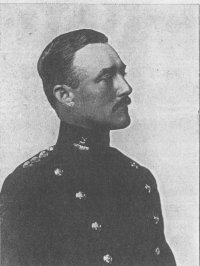
John Stanhope Collings-Wells is one of the finest, most inspirational examples of a gentleman and fine leader that it has been my pleasure to come across whilst studying the war. Whatever source of information I find, the message is the same; he was truly admired and respected both before the war and during, regardless of the rank or status of the people who commented on him. John Collings-Wells is one of those people that leave you wandering what he could have achieved should he have survived
He was born in Manchester on 19th July 1880. Having been educated in Christchurch College, Oxford, in 1906 John went to live with his Cousin, Will Buck, at Field House in Marple to run his father's business in Manchester until war arrived in 1914.
Second Lieutenant Collings-Wells was commissioned into the Bedfordshire Regiment on 14th March 1904 having previously served with the Hertfordshire Militia. He became a Lieutenant in September 1904 and Captain in January 1907. On the outbreak of war he was recalled to the colours and arrived in France with the Bedfordshire Regiment on the 22nd August 1914, where he served in the 2nd Battalion once they had arrived from South Africa. By October 1916 he was promoted to acting Lieutenant-Colonel in command of the 4th Battalion and remained at that post until his death.
At the Battle of Arras in April 1917, he won the Distinguished Service Order whilst commanding his Battalion and less than a year later he was posthumously awarded the vaunted and well earned Victoria Cross for what can only be described as incredible, unstinting valour in the face of extreme adversity. Ironically, as with many of life's heroes, he was killed shortly after the worst fighting and his body was unidentifiable, hence could not be appropriately honoured and buried. Fate or coincidence - whichever one you believe in the most - made his identification possible and Lt-Colonel Collings-Wells was afforded the proper burial and identification, as will be seen later.
Throughout the war his Cousin's wife - Flora Buck - worked as a nurse at the Brabyn's Military Hospital at Brabyn's Hall. Fortunately for us, she kept a scrapbook of the events around and affecting Marple. This scrapbook is a valuable source of information and can be seen on request in the heritage section of Marple library.
Captain John Collings-Wells arrived in the 2nd Battalion on the 6th November 1914 whilst they were resting at Locre having been heavily engaged at Ypres in the previous weeks. Having survived two dreadful months in the atrocious conditions faced by the British troops that Winter, Captain Collings-Wells was badly wounded on the 12th January 1915 and invalided home as a result.
Having eventually recovered, John returned to France with the newly mobilised 4th Battalion, who saw action on the Somme and at Ancre in 1916, at Arras and Ypres (Passchendaele) in 1917 and during the massive German Spring Offensive of 1918.
On their arrival on the Western Front in July, John was a Company Commander but on the 4th September 1916, he was promoted to Major and became 2nd in command of the Battalion. After the Battalion had suffered badly during the Battles on the Somme and later at the Ancre that November, he found himself in command of the Battalion from Christmas Eve onwards, as they bedded into trench life that Winter, waiting for the new campaigning season to commence.
John was unfortunate enough to be on General Gough's FGCM panel who were called to try the sad case of the Nelson battalion's Sub Lieutenant Edwin Dyett's desertion on Boxing Day, being only the third day of his command. The rights and wrongs are for others to debate elsewhere but Sub-Lt Dyett was shot at dawn on the 5th January 1917, his last words being "Well boys, goodbye. And for God's sake, shoot straight." He lies in Le Crotoy Cemetery on the Somme.
His strong leadership was already noted and respected by that time. His great organizational ability, attention to detail and the way he seemed to know almost every individual in his Battalion by name made him a highly respected leader whom the men of the 4th Battalion were always keen to follow and aspire to be more like. He was always first into the attack and last to withdraw, only when his men had been successfully moved to safety. His prevailing thought when faced with combat decisions was "Will this benefit the Battalion", which shone through to all subordinates, thus inspiring them to achieve great deeds if he so called for them.
In 1917 Lt-Colonel Collings-Wells led his Battalion in the Arras Offensives and captured a portion of Gavrelle despite horrendous casualties. In recognition of his incredible leadership and personal gallantry, he was awarded the Distinguished Service Order.
The report in the London Gazette records:
"D.S.O. - Capt. (Acting Lieut.-Col.) J.S.Collings-Wells. He commanded his battalion during the operations on the 23rd and 24th April 1917, with marked ability. The battalion captured the northern outskirts of Gavrelle on the 23rd April, and held their ground, in spite of frequent counter-attacks. When the situation required clearing up, he proceeded through the town under heavy shell and machine-gun fire to re-organise the battalion, and immediately informed the disposition of his companies. On the 29th April he was placed in command of a composite battalion with orders to attack and capture the Oppy line of trenches between the ground then held by the 188th Brigade and the 2nd Division. It was chiefly owing to his leading, coolheadedness and disregard for personal safety that the battalion reached their place of assembly, and formed up under shellfire in darkness on practically strange ground, and subsequently achieved its objects. His courage on this occasion inspired all ranks, and was greatly instrumental in carrying the operation through successfully."
Lt-Colonel Collings-Wells also led his Battalion through their involvement in the Third Ypres Battles (also called Passchendaele) was also Mentioned in Despatches in November 1917 in relation to his DSO. He also stepped in to temporarily command the 190th Brigade several times during 1917.
The now infamous German spring offensive began to take a heavy toll on the 63rd (Royal Naval) Division a full nine days before the actual infantry assault was launched. The Germans flooded the area with mustard gas, costing the 4th Battalion 5 officers and 264 other ranks before the battle had even started. The entire 63rd Royal Naval Division lost some 2000 men before the opening day of battle - 21st March 1918.
When the expected German attack finally started the Battalion were in reserve positions but were not long out of the action. History records that the Germans attacked with such force that the allies began a fighting retreat almost immediately, their front lines having been quickly smashed and overrun. British General scrambled their reserves into position and Collings-Well's Division were moved twenty miles into positions on the old 1916 battlefields of the Somme over just 4 days, conducting several fighting withdrawals in the process. In a matter of days, the Germans had recovered the ground it had taken the Allies almost two years to capture and British forces were stretched to the extreme, yet held "to the last" bullet or man, thus making the Germasn pay dearly for their successes. During these fighting withdrawals, Lt-Colonel Collings-Wells personally led small parties of his men who covered the withdrawal of the bulk of the Battalion by fending off ridiculous numbers of advancing Germans against the odds. The action on the 24th saw them stay until they had run out of ammunition, yet they managed to withdraw and reorganize further back.
On the 25th March he took his battalion up to High Wood to reinforce the 189th Brigade who were very hard pressed. Once again he proved his natural leadership ability under the most strenuous conditions and his men were soon heavily engaged in action. Once again they stayed until every round of ammunition had been used. As before, Collings-Wells realised that his men would soon be surrounded so he called for volunteers to help him hold up the Germans whilst the remainder escaped. Once the withdrawal was complete John lead the rearguard to safety himself.
That evening they withdrew to the Thiepval Ridge and on the 26th crossed the River Ancre, destroying all the bridges once safely over. At 7pm the Battalion moved into position between Aveluy and Bouzincourt - 1 mile north of Albert - and were now told to hold the Germans again as they advanced north out of the recently captured town of Albert.
Having been ordered to counter attack Bouzincourt Ridge near Albert on the 27th March, he rallied and led the exhausted Battalion in the attack himself - as usual - and was wounded in both arms in the process. Although he was wounded in both arms, he led the remnants of his battered Battalion, who took the position despite appalling enemy fire and drove the German Army back. A wounded Sergeant saw that Collings-Wells was almost physically dragged to a bunker to have his wounds dressed as he was extremely reluctant to leave his men. Moments later the bunker received a direct hit from a mortar shell and the 37 year old Collings-Wells, his second in command Major Nunnelly and two other officers, including the medic were killed outright. Sadly, his body could not be correctly identified so their personal effects were removed and the casualties were buried without knowing who was in which grave.
The War Diary simply records:
"27 Mar 1918 - west of Albert. Batt. was moved south to a position W of ALBERT where they attacked the Railway at 7.30 a.m. Lt.Col. J.S.COLLINGS-WELLS, D.S.O. MAJOR G.P. NUNNELEY, 2/Lt. D.H.MACKLIN, 2.Lt. O.J.SOAMES killed, Lts.C.KEITH-JOHNSTON M.C. J.B. PRIMROSE-WELLS. 2.Lts. L.HAMBLING & W.BROUGHTON wounded. Capt.L.G.PLUMBLY M.C. took over command of the Batt. temporarily from this date."
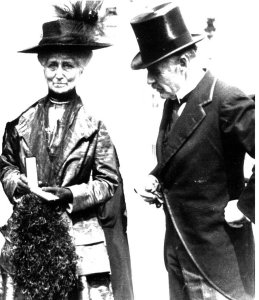
For his actions between the 21st and 27th March 1918, John Stanhope Collings-Wells was posthumously awarded the Victoria Cross which was received at Buckingham Palace by his parents in June of that year, as can be seen in the photograph. The London Gazette dated 31-3-1919 (page 4155) records:
"The services for which the Victoria Cross was awarded by His Majesty to the undermentioned Officers, Warrant Officers, Non-Commissioned Officers and Men were performed at the places and on the dates mentioned: Capt. (A./Lt.-Col.) J. S. Collings-Wells, D.S.O., late 4th Bn., Bedf. R. Theatre of War : Marcoing to Albert, France. Date of Deed : 22/27.3.18 Date of Gazette : 24.4.18"
The London Gazette citation dated 24-4-1918 adds:
"His Majesty the KING has been graciously pleased to approve of the award of the Victoria Cross to the undermentioned Officers: Capt. (A./Lt.-Col.) John Stanhope Collings-Wells, D.S.O., late Bedf. Rt For most conspicuous bravery, skilful leading and handling of his battalion in very critical situations during a withdrawal. When the rearguard was almost surrounded and in great danger of being captured, Lieutenant - Colonel Collings-Wells, realising the situation, called for volunteers to remain behind and hold up the enemy whilst the remainder of the rearguard withdrew, and with his small body of volunteers held them up for one and a-half hours until they had expended every round of ammunition. During this time he moved freely amongst his men guiding and encouraging them, and by his great courage undoubtedly saved the situation.
On a subsequent occasion, when his battalion was ordered to carry out a counterattack, he showed the greatest bravery. Knowing that his men were extremely tired after six days' fighting, he placed himself in front and led the attack, and even when twice wounded refused to leave them but continued to lead and encourage his men until he was killed at the moment of gaining their objective. The successful results of the operation were, without doubt, due to the undaunted courage exhibited by this officer."
One of the reporters in "The Times" edition of the 16th April 1918 wrote:
"For his able leadership on a recent occasion he was awarded the D.S.O. Possessing a wonderful grasp of detail and great organising ability, Lieut.-Col. Collings-Wells raised his battalion to a pitch of high efficiency. Endowed with untiring energy and activity, he stimulated a similar keenness in his officers. He was wedded to his battalion and spared no efforts to promote the welfare and comfort of his men. Perhaps his most striking characteristic was an extraordinary coolness and intrepidity under shellfire, which on many critical occasions inspired his men with confidence and cheerfulness in the face of danger."
After his death, the Acting Adjutant Captain J.H. Blackwell wrote to John's parents:
"I believe [name censored] has written to express the deep sympathy of the whole battalion in the death of your son, our Commanding Officer, whom every officer, NCO, and man loved and admired. He was killed on March 27th leading the old battalion into action, and it was entirely due to his energy, skill and attack, and not least his wonderful personality, that the operation was so successful …. I have learned to admire and love him. His every action, however small, was guided by the thought, ' Will this benefit the battalion?' and the very few who did not realise what he was doing for them will do so now…..Major Nunnelly [the second in command] was also killed at the same time, so [entry censured, but was Captain .B. Knight, M.C. who was to receive a Bar to his MC for his involvement in the fighting that claimed John's life] is commanding. I am glad he is spared for I think he knew and loved the Colonel as much as myself "
In another letter to John's mother, the Regimental Sergeant Major J.C. Pearce, who was mentioned in the same 1917 despatches that John was, further illustrates the Battalions feelings on their former CO:
"Dear Madam,
Many friends of my late commanding officer will bring to you in this your hour of trial and sorrow many reminders of your sons great qualities, but with all the respect in my nature to the mother of one of England's greatest leaders of men, I beg to inform you there are none outside his home circle of friends who will always remember him better than we, his children. He was our father, both at play and work, at fighting he was above all our leader. Our wants and pleasures were his first thought day in and day out, we became first in his mind before all things. He taught us all we knew with an unexampled sense of brave leadership, which at all times carried us to victory, never once did he give an order to any of us which he was not prepared to carry out himself. I personally have seen him in what we know as "tight corners", I have seen him when the situation was more than critical, it has looked almost hopeless at times of late, but with that well known calm of his, which carried with it coolness and confidence to all around him he has brought us through. There are places which will go down to history, the names of which I must not mention, he with a few picked men of my battalion has held them to the very last moment, while the remainder of the battalion has got away to safety, always the first to lead and the last to leave the place which was vital to our line remaining intact and never once did they get through our line. The C.O. asked for and obtained from his boy's a little more than the best, whilst his maxim to us was "Smile on, fight on and stick it" and no matter what the duty or how hard the conditions, never did they finish that duty without a song on their lips, only too happy to please their beloved leader. They loved him because he was always just and fair in his condemnation of fault, they loved him for his kindly thought in all things appertaining to their welfare and best of all they loved him for leading and being with them in action. When things grew hot we have known him use the rifle like his men and even bomb the enemy like any of the boys. His name was on the lips of those who had only been with him a matter of days, they all knew him for what he was, a fighter first and last and a great leader all the time. My Colonel inspired coolness and self determination with the spirit to win, to all of us, we shall never meet his like again. Dear Madam, your trial and loss is great, but England's loss is greater, our C.O. led my dear old battalion, we know he could have directed larger forces, therefore I beg to state that our England's loss is even greater than yours, but today our thoughts are with the mother of our leader, your sorrow is our sorrow, your loss is our loss, but our pride and memory of him will be ours always.
Trusting these few lines will not pain the brave mother of the bravest of sons, please accept the salute of Yours Faithfully J.C.Pearce A/R.S.M. B.E.F. 9.4.18."
King George V also sent his parents a message on the 3rd May 1918 saying:
"It is a matter of sincere regret to me that the death of Captain (Acting Lieutenant-Colonel) John Stanhope Collings-Wells DSO, 4th Battalion Bedfordshire Regiment, deprived me of the pride of personally conferring upon him the Victoria Cross, the greatest of all awards for valour and devotion to duty. George RI"
John's remains were known to be buried in one of the graves from those who were killed in the dugout on 27th March 1918, but the Commonwealth Wargraves Commission could not say for certain which one. Although it is always saddening when men cannot be identified for a proper and appropriate burial, a heroic and inspirational gentleman such as Collings-Wells being buried in an unknown grave seems to make this sad ending slightly sadder still. However, a peculiar sequence of circumstances changed things, as described in an undated letter to "The Times", concluding this incredible story rather nicely:
"Dear Sir,
When serving as a junior commissioned officer in the 4th Battalion of the Bedfordshire Regiment (then attached to the 63rd Division) in France during 1916 I was invalided from the trenches and sent to the nearest base, where I underwent medical treatment until fit again for active service. Before leaving my battalion in 1916, and at the special request of one of our then Captains, I gave him my map case, bearing my own name stamped thereon, having no further need for it. I thought no more of the matter until about a couple of years ago, when I received a communication from the Imperial War Graves Commission, returning the same map case, battered and mud-stained almost beyond all recognition. They informed me that it had been found with the remains of an officer in the Bedfordshire Regiment, identified as such by the tunic buttons, who, it was thought, had fallen early in 1918. I immediately identified the map case as the one I had formerly given to Captain Collings-Wells, of my own battalion, when I left them in 1916, and informed the Imperial War Graves Commission to that effect. This officers relatives were inclined to accept this evidence, after consultation with the authorities at the Imperial War Graves Commission, and a memorial cross is now being erected at Bouzincourt Ridge Cemetery, near Albert, to Lieutenant-Colonel J.S. Collings-Wells V.C D.S.O., etc.
Yours faithfully, G. Martin"
Lieutenant-Colonel John Stanhope Collings-Wells, V.C., D.S.O. of Field House, Marple was killed in action 27th March 1918, aged 37. He was the son of Arthur and Caroline Mary of Brands House, Hugenden, High Wycombe in Buckinghamshire.
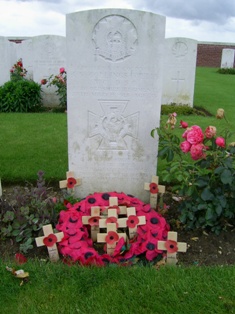
He is buried in Plot 3, Row E, Grave 12 in the Bouzincourt Ridge Cemetery, France and remembered on the All Saints War Memorial, Marple, St. Ethelreda's Church, Hatfield, Hertfordshire, The Collings-Wells Memorial Hall in Caddington, Bedfordshire, The Christ Church College Plaque, Oxford and on the East window of St. John the Baptist Church in Markyate. "Collings-Wells Close" in Caddington is also named after John, ensuring his name lives on, as it should.
John's parents at Buckingham Palace June 1918
John's gravestone
Site built by Steven Fuller, 2003 to 2023