The Bedfordshire Regiment in the Great War

Private 7602 Edward Warner, V.C.
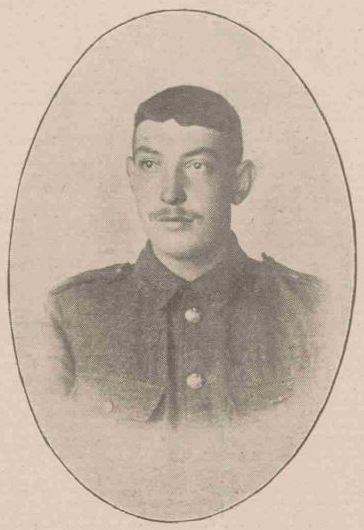
All Victoria Cross stories naturally carry a special element within them, given the very nature of the award. This is one that shows an incredible level of personal bravery and an utter disregard for his own life. Given that Private Warner was to win his V.C. in the middle of the deployment of a terrifying new weapon that no one was absolutely certain about and had only been unleashed for the first time in history (with devastating effect) a few days earlier, his actions can only be considered as staggering.
Edward, known as Ted, was born 18 November 1883, at St Albans in Hertfordshire. Although his father had previously been married to Ann Lowe, it appears that Edward was the only son of Mark and Charlotte Warner. Mark was a Platelayer Foreman on the Railways who was born in Wheathampstead around 1832 and his mother Charlotte (formerly Barber) was from London, being born around 1841.
By 1901 the 17 year old was a Straw Hat stiffener and, probably inspired by the South African War stories that impressed so many young men into joining the army around that time, enlisted into the Bedfordshire Regiment late in 1903. He served in India before the battalion returned to home shores in 1908 and was a Reservist when war broke out, with only a matter of months to serve, an elderly and widowed mother to care for and a fiancee tor eturn home to.
Private Warner joined the 1st Battalion in Ireland as it organised itself ready for war service, and landed in France with the battalion who were amongst the first wave of British troops to arrive on the Western Front on the 16th August 1914. He fought with them at the Battles of Mons, Le Cateau, the Marne, the Aisne, at Givenchy and Ypres before winter set in. After their first winter in the shallow, temporary trenches the battalion were stationed at the tactically critical mound of mining slag called Hill 60 in April when it was wrestled from the Germans' grasp. The importance of the low rise ensured the German's made determined efforts to re-take the position that commanded a view onto Ypres itself and, within days of history's first ever gas attack, launched the lethal weapon onto the unsuspecting British Tommies once again.
Edward and his comrades had taken over the firing trenches on the 25th April 1915, to the left of Hill 60. On the 6th day of them being there they were extremely tired, having held the position for almost a week with very little sleep or rest. Early on the morning of the 1st May, the Germans suddenly attacked with gas shells and a concentrated artillery bombardment. The battalion were adept to sheltering from the German shells by then but could do nothing about the Gas and were forced back. Although some of the German soldiers attacked, most of them could not as the gas blew back onto their own positions, stopping them from leaving their trenches.
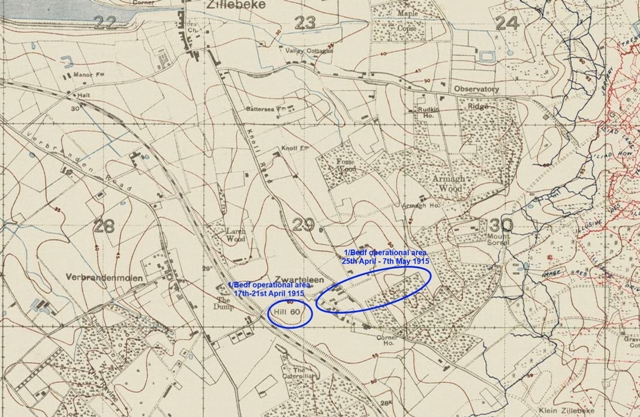
The Bedfords in Trench 46 were driven out, leaving the position completely undefended. However, it would appear that Edward was not happy about events and jumped into the empty trench by himself, keeping the Germans that were attacking from entering and taking control of the trench single handedly. We can only imagine the struggles with his own uncertainty and fear, created by the strangely coloured gasses drifting across the battlefield, with him not knowing what this dreadful new weapon would do to him. Despite the psychological effects of the gas, exhaustion and repeated attempts by the enemy to gain a footing in his small section of the battlefield, the completely isolated Private Warner simply kept going. When he had the chance, he ran back to the Battalion and gathered some men to go back with him to carry on defending the trench. Exhaustion and the effects of the Gas he had breathed in eventually forced him to his knees and he was carried back to the First Aid post for treatment.
An extract from 1st Bedfordshires. Part One; Mons to the Somme, tells of how his close friend, Ted Brimm from St. Albans, saw his pal the following morning:
The night quietened down and on the morning of 2 May Fred Brimm found his mortally wounded friend, Ted Warner, 'more dead than alive' at the nearby Regimental Aid Post. He wrote: 'Ted was quite sensible to within half an hour of his death. He knew he was going and only wanted another chance to get at them again. His last words were "They've gone and done for me, the cowards." Fred added that, 'Whenever I go near his grave, I see that it is alright.'
Unfortunately Ted had simply been exposed to the new, deadly weapon for far too many hours and he died the following day, suffering from the dreadful effects of Gas Poisoning, without knowing that he would be awarded the highest medal for gallantry in the British Empire.
Edward's final resting place was lost in the fighting that raged across the ground for a further three years and he has no known grave. He is remembered on the Menin Gate Memorial, Ypres, Belgium and is also listed on the St. Albans War memorial in Hertfordshire.
Edward's Victoria Cross was recorded in "The London Gazette", Issue No. 29210, dated 29th June, 1915. It reads: "For most conspicuous bravery near ' Hill 60 ' on 1st May, 1915. After Trench 46 had been vacated by our troops, consequent on a gas attack, Private Warner entered it single-handed in order to prevent the enemy taking possession. Reinforcements were sent to Private Warner, but could not reach him owing to the gas. He then came back and brought up more men, by which time he was completely exhausted, but the trench was held until the enemy's attack ceased. This very gallant soldier died shortly afterwards from the effects of gas poisoning."
A week later the news of his award filtered back to his former comrades on the front lines, as the 1st Battalion War Diary reads: "5 Jul 1915 In support Pte E.WARNER (since deceased) awarded Victoria Cross for gallantry on May 1st near Hill 60."
Edward's Victoria Cross is displayed at the Bedfordshire and Hertfordshire Regimental museum, Wardown Park, Luton, along with his 1914 Star, Victory and British War Medals.
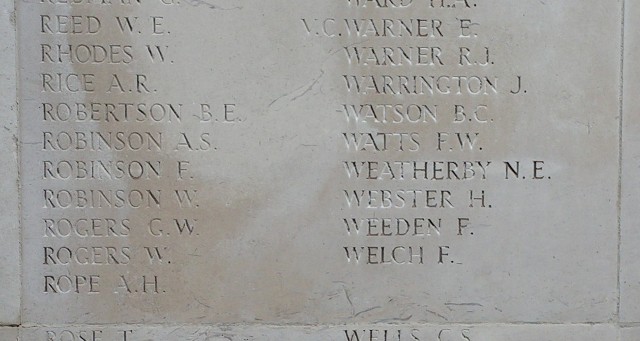
Edward Warner on the Ypres (Menin Gate) Memorial to the missing
Site built by Steven Fuller, 2003 to 2023